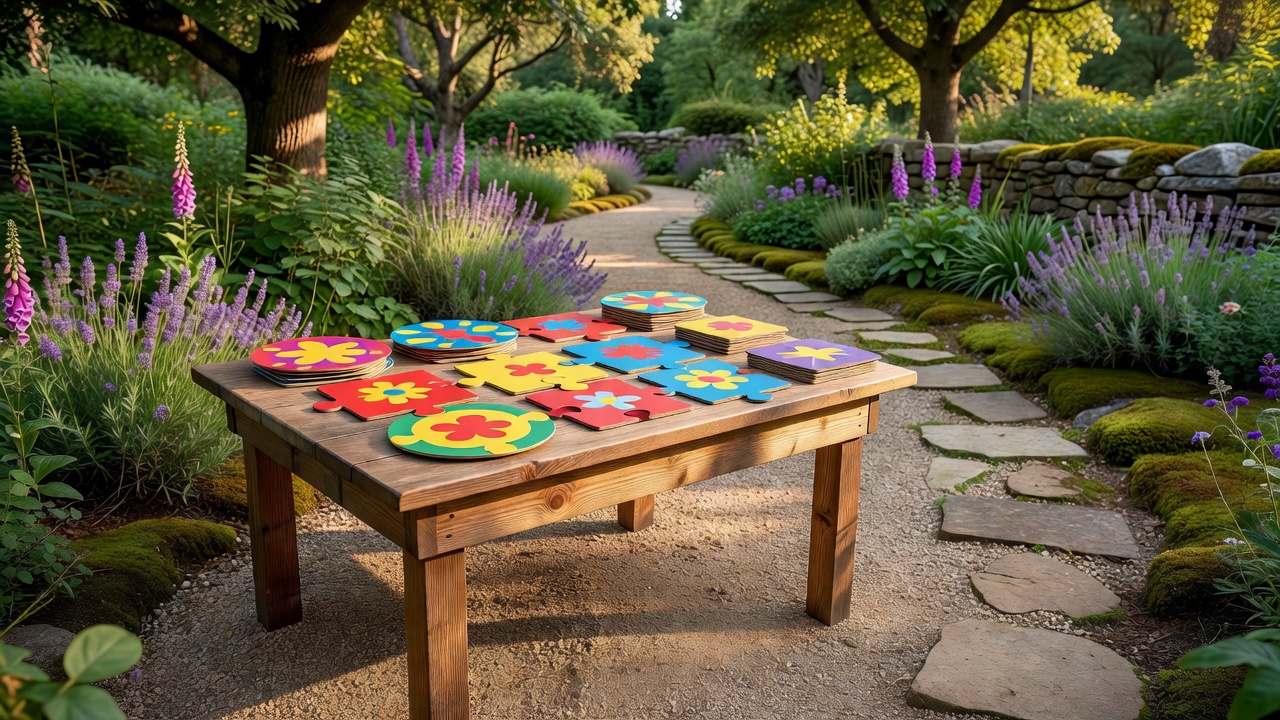
Choose a position people can use
Look for firm, reasonably level ground beside the route, not in the middle of it. The group should be able to stop without blocking a gate, a path junction or access for other visitors. Check the approach as well as the station itself: a reachable tabletop is not useful if the only way to it crosses loose ground or a step.
Use a stable freestanding surface with the owner’s permission. Avoid attaching anything to trees, fences, memorials or visitor signs. Check for sharp corners, wobbling legs, pinch points and trailing cords. Do not use stakes where services, roots or site rules make them inappropriate. If you cannot secure the setup safely without disturbing the space, choose a different arrangement.
Ask participants about reach and working height rather than treating one measurement as universally accessible. Provide materials that can be brought to a seated player and a clear area for approaching the task. Keep essential clues on the front or top surface, not underneath furniture or behind an object that must be lifted.
Give the group one shared action
A useful first station is an ordering puzzle. Provide four large cards showing a fictional gardener’s morning: collect the empty watering can, fill it at the marked tap, carry it to the planter, then return it to the shelf. Give enough contextual information that the intended order is explicit. Avoid requiring players to infer a gardening practice that may vary in real life.
Put a letter on each card. When the story cards are arranged in the stated sequence, the letters can spell GATE. The instruction beneath should explain that the answer identifies the next labelled stop on the map; it should not invite anyone to open a boundary gate. Use a printed route label or a facilitator confirmation to remove uncertainty.
Another option is a matching board: pair a large leaf silhouette with the corresponding reference photograph, then read the station symbol attached to the pair. Use your own permitted photographs or properly licensed printed materials. Keep answer checking separate from the artwork so a player does not accidentally solve the puzzle by spotting a different card size or print mark.
Cooperation needs room in the task. Spread the information across several cards, let one participant read the story and another arrange the sequence, and invite someone else to verify it against the instructions. Do not make the entire group watch one person open a small lock. A lock can be atmospheric, but it is optional and should always have a facilitator override.
Lay out instructions in a predictable order
Give every station the same visual hierarchy: station letter, story sentence, task, answer format and next action. The first line might read “Station C: arrange the four cards.” The last might read “Read the letters from left to right, then find that word on your route map.” A player should not need to sift through decorative text to learn what to do.
Provide a large-print copy and enough contrast for shaded conditions. The Web Content Accessibility Guidelines, WCAG 2.2, concern digital content, but their emphasis on perceivable information is a helpful design reminder for your printed materials too. Do not claim that a printed station is certified accessible merely because its colours resemble a web contrast example.
Avoid glass, flames, sharp tools and tiny loose pieces. Consider choking risks, allergies and participant needs when selecting materials. Keep food rewards separate from outdoor puzzle handling, and provide a non-food alternative.
If you add a story about a missing gardener, keep the mystery clearly fictional and welcoming. A sealed letter, a misplaced map or a forgotten welcome sign can provide intrigue without pretending that someone is in genuine danger. Explain any startling elements beforehand and offer a quieter way to participate.
Make the reset part of the design
Photograph the correct starting layout for your own reference. Mark the backs of cards with a small station identifier and keep each station’s spare set in a separate folder. Record which side faces up, where the hint belongs and what the facilitator should collect before another group arrives.
| Item | Starting state | Reset check |
|---|---|---|
| Instruction board | Visible at the front | Dry, readable, stable |
| Four story cards | Mixed order, face up | All present and unmarked |
| Hint card | Held by facilitator | Returned to folder |
| Route map | Available to the group | Next destination matches |
Test the reset with someone who did not build the station. If they cannot restore it from your notes, simplify the setup. Leave enough time between groups to check damage and missing pieces rather than only rearranging the visible cards.
- Approach and exit remain clear.
- Materials are stable, reachable and easy to read.
- The task has a hint and a direct bypass.
- The answer produces a definite next move.
- Every piece is collected at the end of the activity.
Weather alternative: a station that travels
Keep the puzzle in a portable folder or shallow tray that a facilitator can move to an authorised sheltered space. Avoid loose covers that can blow away. If rain, heat or wind makes gathering unsafe, stop the outdoor route and use the prepared indoor version.